Isolated FID minimum
3.5374 is a historical point under one protocol, not a universal score.
Bachelor's thesis · University of Jaén · 27 Jun 2023
I designed, trained, and compared generative models to produce car images. This version preserves the evidence, explains the limitations, and never pretends the original run can still be reproduced.
Visual evidence
The selected thesis epoch produced recognisable vehicles. Several samples also repeat structure, colour, and background: visible evidence of insufficient diversity.
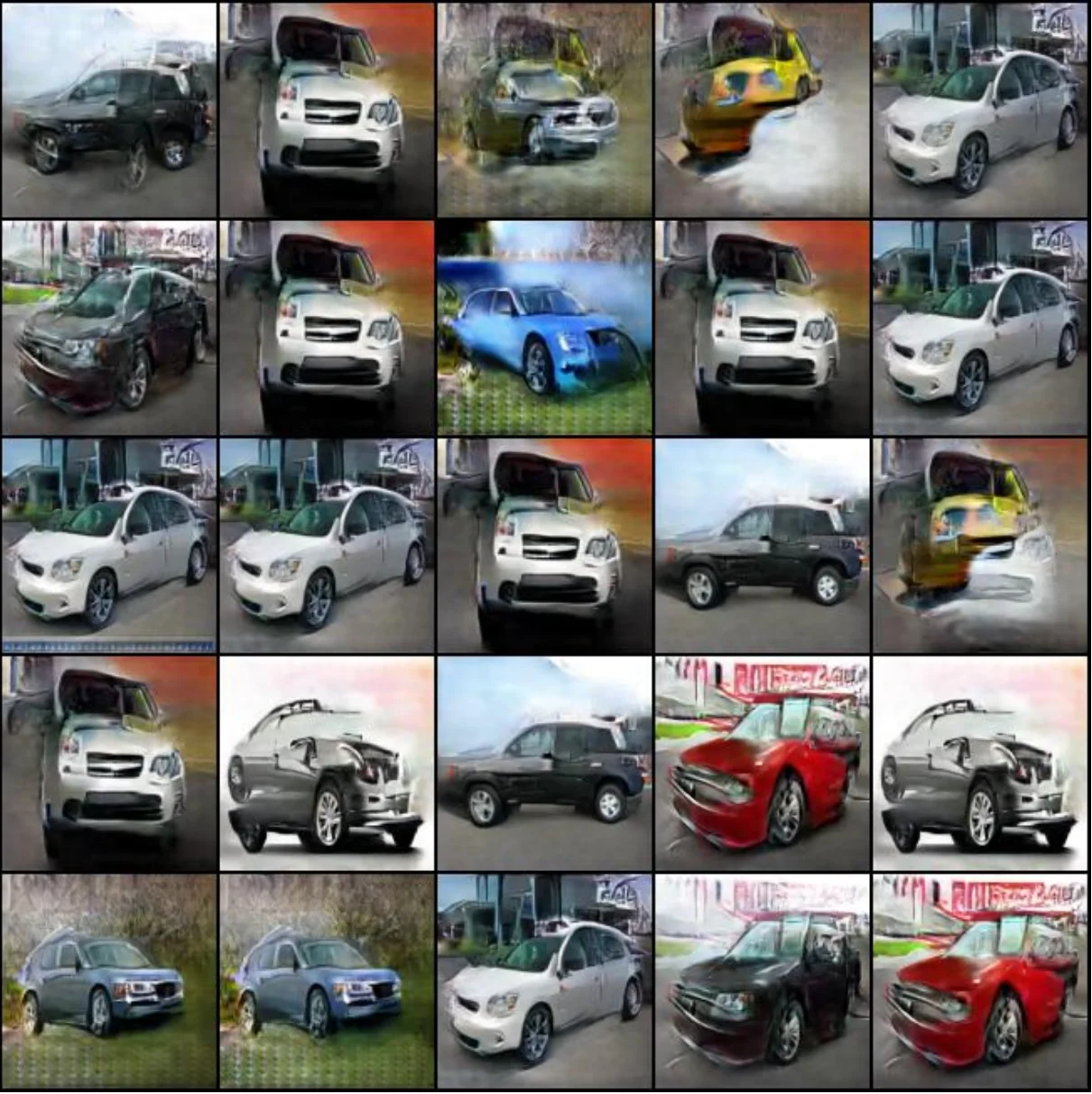
3.5374 is a historical point under one protocol, not a universal score.
After the minimum, FID and generator loss deteriorate while discriminator loss reaches zero.
The recovered code mixes train and test; evaluation is not independent.
The work covered research, Stanford Cars preparation, architecture design, training, metric instrumentation, and visual analysis. The recovered material confirms GAN and VAE implementations plus a TransGAN exploration.
A current version would lock seeds and environment, preserve an independent test split, calculate FID 2,048 and KID across multiple runs, and publish density/coverage alongside failed samples.